
A group of girls outside Sainte Monique
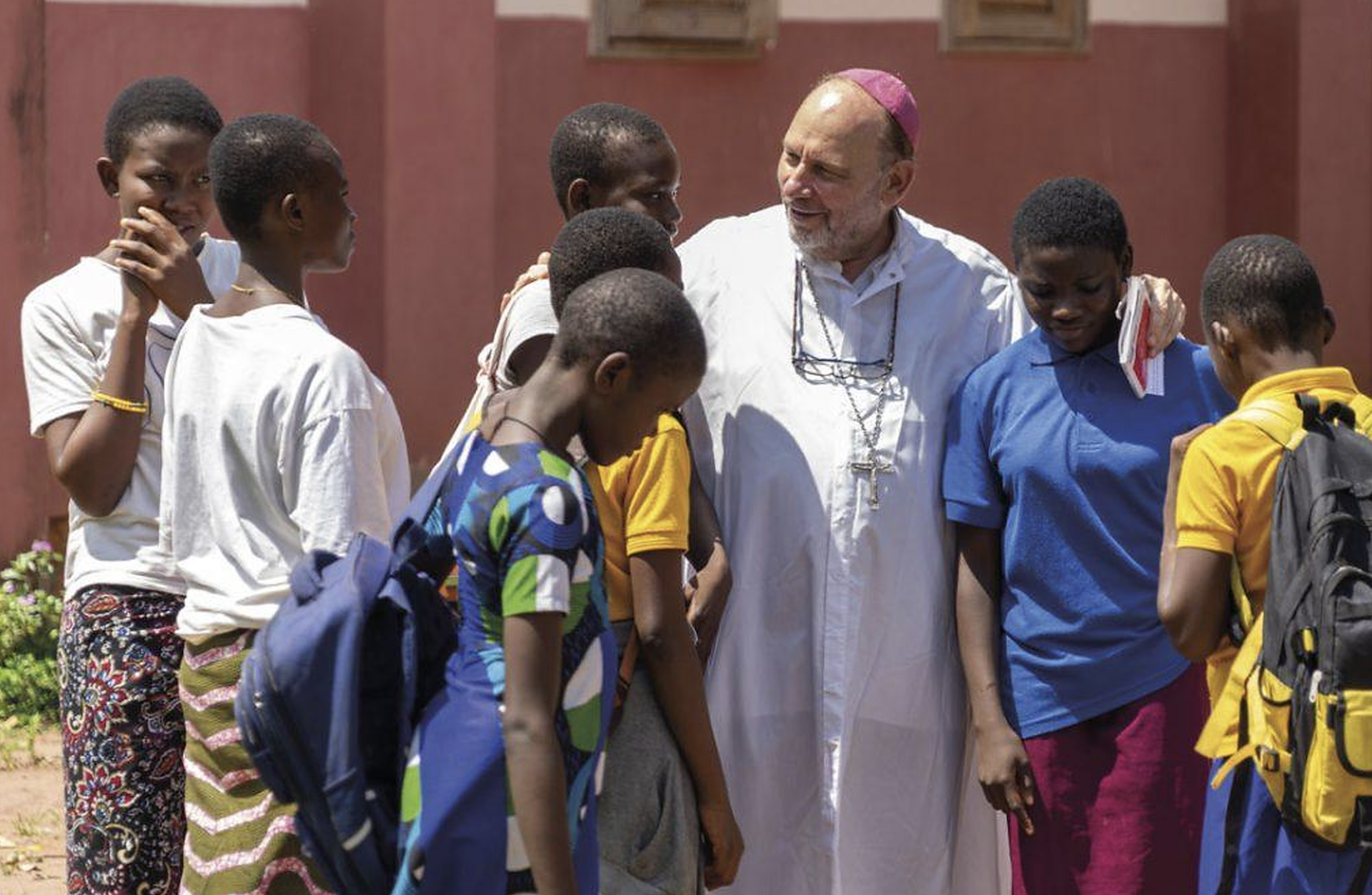
Bishop Jesús Ruiz of Mbaiki at Sainte Monique with several female residents.
By: Enrique Bayo
170 girls are preparing for a better future at the Sainte Monique Boarding School in Mbata (RCA).
The discrimination faced by Central African girls in accessing education compared to boys motivated the founding of the Sainte Monique Boarding School in Mbata. This human development project of the Dominican Missionary Sisters of Africa has received support from the Spanish NGO Manos Unidas, which financed the construction of one of the school’s dormitory buildings.
Two honks of the horn and a few seconds’ wait were all it took for the guard to open the gate of the Sainte Monique Boarding School, located in the Central African city of Mbata, in the province of Lobaye. Before our eyes appeared a large plot of land with several single-story buildings and a few trees, beneath which groups of girls of different ages were chatting animatedly. Some of them recognized the Comboni missionary from Burgos, Bishop Jesús Ruiz, Bishop of Mbaiki, driving the vehicle and raised their arms energetically to greet him.
The car turned left and a few meters later was parked next to the Dominican Missionary Sisters of Africa community. Before we could get out, several nuns were standing at the foot of the vehicle to welcome us “in true African style,” with great displays of joy.
Monsignor Ruiz had warned me that our visit would be short, so as soon as I was introduced to the five nuns of the community—two Rwandans and three Central Africans—I turned on my recorder, hung my camera around my neck, and began asking questions. Sister Clémentine Mbanga, the Central African superior of the community and the main person in charge of the boarding school, offered to accompany me and show me around. She stayed by my side throughout the visit.
It was Thursday, and the older girls were in class, while the younger ones seemed to be enjoying some free time in the schoolyard. No matter how much you looked around, it was impossible to find a serious face among them. I approached one of the girls, Janice, to ask her why she was at the boarding school, and I was very pleased with her answer: “To study and become someone who can be useful to Central African society.” Just to confirm my first impression, I asked the same question to three other students at the school with whom I had the opportunity to speak: Sarah, Miséricorde, and Gwendoline. They all answered more or less the same as Janice: they wanted to get an education to contribute to the good of their country. Seeing the firmness of their words, I understood that it was a message they had deeply internalized and expressed with conviction. The five girls I interviewed were also unanimous in their positive assessment of the affection and support they receive from the Dominican sisters at Sainte Monique.
A project to alleviate a deficiency
The center was founded in 2012 out of sheer necessity. The Dominican nuns and the then-bishop of the Diocese of Mbaiki, the Italian Comboni Monsignor Guerrino Perin, were aware of the low school enrollment rate in the Central African Republic, which in some provinces barely reaches 50% of the population. But above all, they were deeply saddened by the significant discrimination faced by girls, who do not have the same educational opportunities as boys. All of this led them to establish a boarding school for girls where they could receive a quality education. “Our cultural mindset pushes girls to stay home to help their mothers instead of going to school,” lamented Sister Mbanga, “and we cannot accept an attitude that holds girls back and prevents them from moving forward with their lives.” The nun’s words also carried great conviction.
The project’s beginnings were marked by humility. In its first year, it housed four girls; the following year, that number rose to eight. Gradually, thanks to the support of various organizations and Bishop Jesús Ruiz himself, the Sainte Monique Boarding School has grown steadily. Currently, for the 2025/2026 academic year, the center’s facilities accommodate 170 girls between the ages of 7 and 16, although it has a capacity for approximately 200.
A renovated old house with a porch houses the classroom pavilion, while the two large buildings where the girls live, each with five bedrooms, were built after the boarding school was founded. The more recent building was made possible thanks to the support of the Catholic NGO Manos Unidas and houses the primary school girls. The bedrooms are spacious, each accommodating about twenty girls in ten bunk beds with two beds each. The sinks are located in a side corridor inside the building, while the toilets and showers are outside, a few meters away.
To ensure the harmonious functioning of this community, the nuns pay special attention to order. For this reason, in each dormitory, a girl is chosen to oversee cleanliness and maintain discipline among the girls. The same occurs in each classroom, where the students secretly elect their class representative. Austine Mbada, the class representative for the fifth year of secondary school, has taken her role very seriously because, as she explains, “If I’ve been elected, it’s to do what I have to do. If any of my classmates are behaving disruptively, I have to advise her to change and give her good guidance and support.”
Discipline and training
Most of the girls at the boarding school are from the province of Lobaye, which coincides with the diocese of Mbaiki. They come from towns like Boda, Boganangone, Ngotto, the city of Mbaiki, and Mongoumba, but there are also girls from other provinces and even from Bangui, the capital. Schools in the Central African Republic that offer girls the kind of discipline and quality education provided at Sainte Monique are few and far between, so parents who can afford it don’t hesitate to send their daughters to Mbata.
Studying here isn’t free, but the cost is adjusted to each student’s circumstances. Girls whose parents work and have the financial means pay 300,000 CFA francs a year, about 460 euros, while for the other girls the cost is 170,000 francs (260 euros). However, there are special cases. At the initiative of Bishop Jesús Ruiz, the daughters of catechists who are dedicating their lives to the Mission pay only 85,000 francs (130 euros), with the other 85,000 francs covered by the diocese. In the case of the young Pygmy girls, the diocese covers their studies and room and board.
This year there are nine girls. They are all in primary school. “Their academic level is very low and we are forced to assign them to lower grades than they should be in for their age, but it is the only way for them to gain confidence and progress in their studies,” says Sister Mbanga.
Education system
Nine teachers, eight men and one woman, are responsible for teaching the classes. The Dominican nuns take special care in the selection process for the teaching staff. They are required to prepare their lessons well and to set a good example, but, in addition, Sister Clémentine indicates that, “in dialogue with them, they have been asked not to make things easy, to be demanding when evaluating, because here people like things to be easy.” She herself is a teacher and teaches Geography and History both at the boarding school and at the public school in Mbata. “At that school,” says the nun, “I am the only woman who teaches. It is very difficult for women to reach a level of education that allows them to become teachers. In the entire province of Lobaye, there are only 13 female primary school teachers, while there are hundreds of men. Fortunately, this mentality of relegating women is changing, and our boarding school is an expression of that change.”
The Central African education system comprises six years of primary school (Fundamental 1), four years of secondary school (Fundamental 2), and three years of high school. The years are counted in reverse order to the Spanish education system, so primary school runs from sixth to first grade, while secondary school begins in sixth grade and extends to third year. The three years of high school are second, first, and final year. Passing the final year grants access to university.
The boarding school offers the complete cycles of Basic Education 1 and 2. Although the sisters intend to also begin offering secondary education, this has not yet been possible. However, girls who complete secondary school have the opportunity to transfer to the community run by the Dominican Missionary Sisters of Africa in Bangui to complete their studies. The results, the nuns emphasize, are beginning to show.
One of the first girls to enroll at the boarding school made her first religious profession as a Dominican nun in 2025, and three other young women have gone on to university. Two are in their second year of medical school, and the other began her degree in Geography and History this year. “For us, they are the pride of the boarding school. I’m sure that in 20 years or less, there will be girls who graduated from here who will have become influential people who will help develop our country,” says Sister Clémentine.
Human and spiritual formation
In addition to their academic studies, the Dominican nuns are deeply committed to the human and spiritual formation of the girls who live there. All of them attend the Citizenship Education course taught by Sister Mbanga, as well as receive specific training on life and love. “It’s surprising how little the girls know about sexuality when they arrive at the boarding school; for example, menstruation is a taboo subject. Since their parents don’t explain anything to them, they have to get information from their friends. Here, we try to give them serious training in these very important areas,” the superior explains. This is complemented by practical experience in doing laundry, cooking, making beds and clothes, and knowing how to present themselves and behave in front of adults.
On one side of the center, some of the girls cultivate a small vegetable garden where they grow legumes, vegetables, and fruits, around which a few free-range chickens roam. This activity helps the girls learn to work the land, in addition to producing food for their own consumption. They also raise a few lambs, although, as the Mother Superior points out, a lack of resources has prevented them from developing this livestock activity further.
Regarding spiritual formation, Religion classes are taught by a parish priest. While some of the girls are Protestant and even Muslim, their families were informed before enrollment that the boarding school offers only Catholic instruction. All boarders are required to attend Religion classes and are invited to participate in communal prayer. In addition to Sunday Mass, the rosary is prayed daily at the grotto of the Virgin Mary, located in a corner of the grounds, and on Sundays, 30 minutes are dedicated to silent adoration of the Blessed Sacrament.
Life inside the boarding school
Just 400 meters from the boarding school is the Parish of Saints Pierre et Paul in Mbata, where the girls attend Mass on some Sundays. When possible, a priest comes to the school to celebrate the Eucharist. These occasional Sunday outings and visits to the medical clinic when needed are the only opportunities the girls have to leave the school. Even recreational outings are not planned for weekends, so the entire lives of the residents take place within the confined space of the boarding school.
When Sister Mbanga is asked if this semi-seclusion situation isn’t too burdensome for the young residents, her face reflects a certain resignation. “It’s true that we’d like to go out more. If we had a bus, we could go on excursions, but it’s not possible. The boys are always there, watching the girls. Sometimes they even climb the wall to see what we’re doing, which forces us to have guards day and night to make sure none of them get the idea to jump over. In each of the dormitory buildings, a sister or a member of the support staff spends the night with the residents,” says the nun, who quickly adds that the “girls cope very well with boarding school life. They feel protected and they like being here. During the end-of-year holidays and during Christmas and Easter, they go back home and always tell their parents they’re eager to return to Sainte Monique.”
The center doesn’t have a television room and the girls aren’t allowed cell phones, but every Saturday from 3 to 5 p.m., a session of traditional dance, singing, and short plays is organized, which the residents thoroughly enjoy. On that day, and also on Sunday, the nuns open the small “surprise storeroom” where they keep the snacks, chips, and candy that the parents bring for their daughters, which are then distributed to everyone’s delight.
The gate reopened as Bishop Jesús Ruiz and I got into the car to continue our journey to Mongoumba. Just as upon our arrival, we left the boarding school accompanied by the cheerful greetings of the girls and the nuns who care for and educate them.
