


By: Kathleen M. Carroll
In Uganda, family is everything.
For a young Pompilla (Pompy) Agalo, the lack of a family was a hurdle this bright, energetic girl could not overcome.
When her mother died, Pompy was only about 12. Because her father was from another ethnic group, and their relationship had never been formalized, her mother’s relatives increasingly saw the girl not as kin but as a burden — or worse, as an asset from whom they might profit. Fearing physical danger, forced labor, or even an early marriage arranged against her will, she did what countless uncounted children in northern Uganda have done: she set out in search of another life. She hoped to find her father, and with him, identity and belonging. She found the man, but not the stability she needed.
In Gulu, she found a temporary landing spot at a boarding school run by the Sisters of the Sacred Heart. She built a reputation for being rebellious and rowdy. This girl without a family often lacked the basics—a bar of soap, a bit of sugar. The Mother Superior of the convent helped with small gifts when she could, but as she got to know this restless, recalcitrant child, she knew that she needed far more. She needed a home, and the Sister knew just who could help.
Comboni Missionary Father John Scalabrini was already well known throughout Uganda as a builder of parishes, a founder of schools, and the driving force behind Bishop Cipriano Kihangire, one of the most respected Catholic secondary schools in the country. He had already supported hundreds of students. Out of options to remain in school, Pompy and the Sisters hoped he might sponsor her.
But when he met Pompy, Father John had another idea entirely. He saw past the behavior issues and attitude to the bright future ahead of this girl, if only she had the support she needed, if only she had a home.
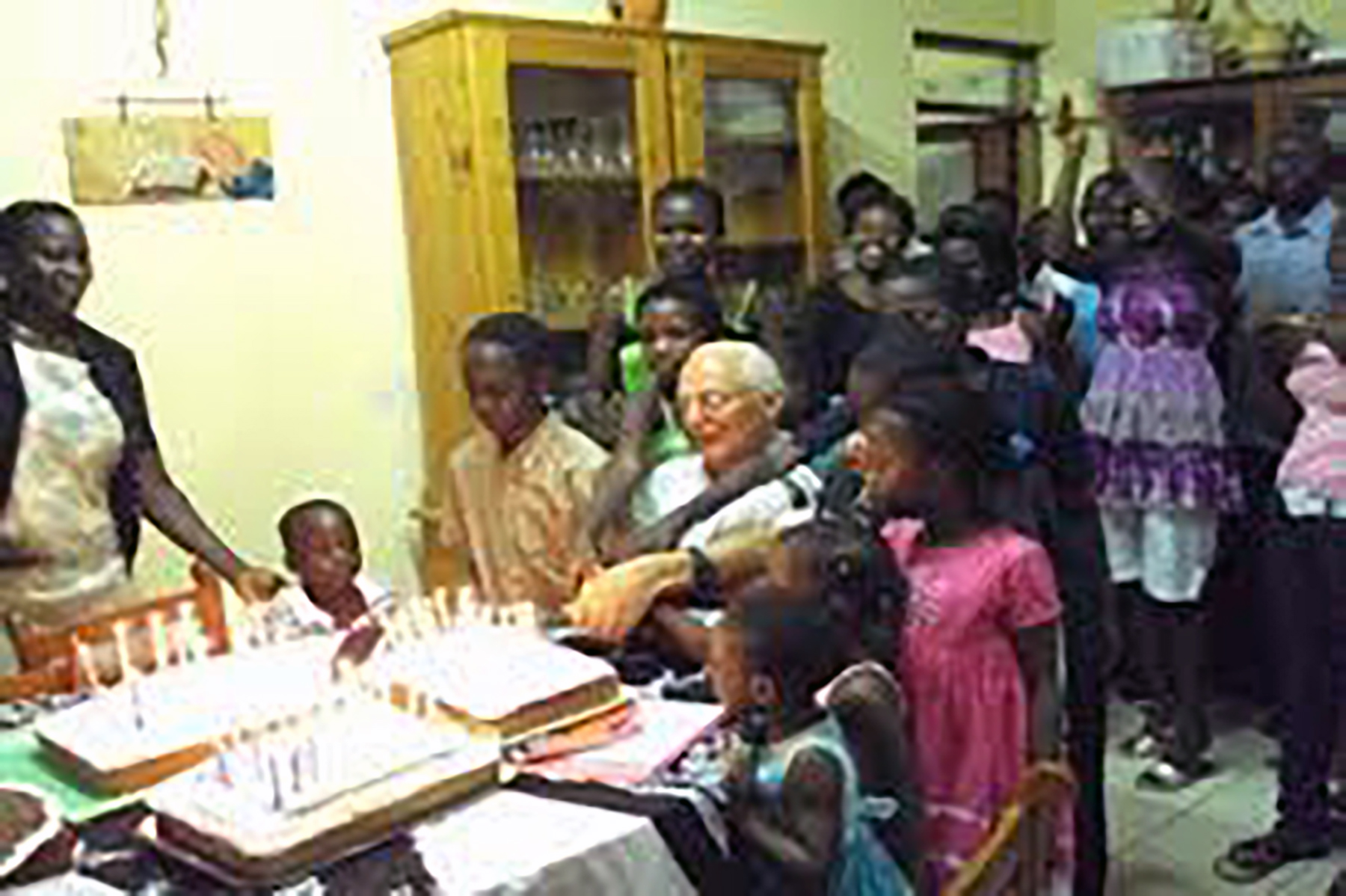
He did not agree merely to enroll her. “You will be my daughter,” he told her. It was an adoption without procedure or paperwork. This was not unusual in Ugandan culture, and certainly not unusual for Father John. He had already built a family. There were those who lived in his home for a few days on their way to a more permanent setting, those he supported in school, and those, like Pompy, whom he cared for and raised like a father.
Skeptical at first, Pompy realized that she had no other option. She accepted Father John’s offer.
Life in the Scalabrini household was loud, prayerful, and demanding. Father John was always the “last to sleep, first to rise,” Pompy remembers. There were chores, meals, bedtime blessings, and, when the need arose, a firm, sometimes shouted, correction.
Pompy tested him at every turn, half-expecting—half-daring—him to tire of her and send her away. But he never did. The longer she stayed, the more she understood that his welcome was not conditional. She was no one’s burden now; she was someone’s child.
Under his roof, she finished school. She tried radio for a brief time (to his great exasperation when she became a late-night host), but he always challenged her to live up to her potential, and his own exacting ideals. At his urging she returned to Bishop Cipriano Kihangire—this time not as a student but as a teacher. The students recognized her voice from radio long before they knew her story. They gathered around her first as a “big sister,” and eventually as something more—someone who could recognize their wounds because she had survived her own. They shared with her things they could not bring to administrators or teachers: fear, shame, assault, despair, the hunger to belong.
Where others might have seen discipline problems, she saw children reaching for rescue. She had once been one of them.
Those restless after-class conversations became a mentoring circle. The circle became Our Voices Now (OVN)—a space where girls could speak aloud the things they had been taught to hide. From there grew the practical-skills arm—tailoring, crafts, simple entrepreneurship—so girls could fund their schooling through their own work.
Father John died in 2016. At the time, he was supporting 300 children at Bishop Kihangire school. It’s hard to put a number on the members of the family he built in Kampala; the figure is doubtless impressive, but still, the quality outshines the quantity. The family he formed is today scattered across Uganda and beyond, but they are still a family.
Pompy is clear: her success is not self-made. “He did not merely sponsor me,” she says. “He made me somebody’s daughter. And that became the doorway to everything else.”
Fr. John gave her more than an education, more than even a home. He gave her a family.
And, in Uganda, family is everything.
