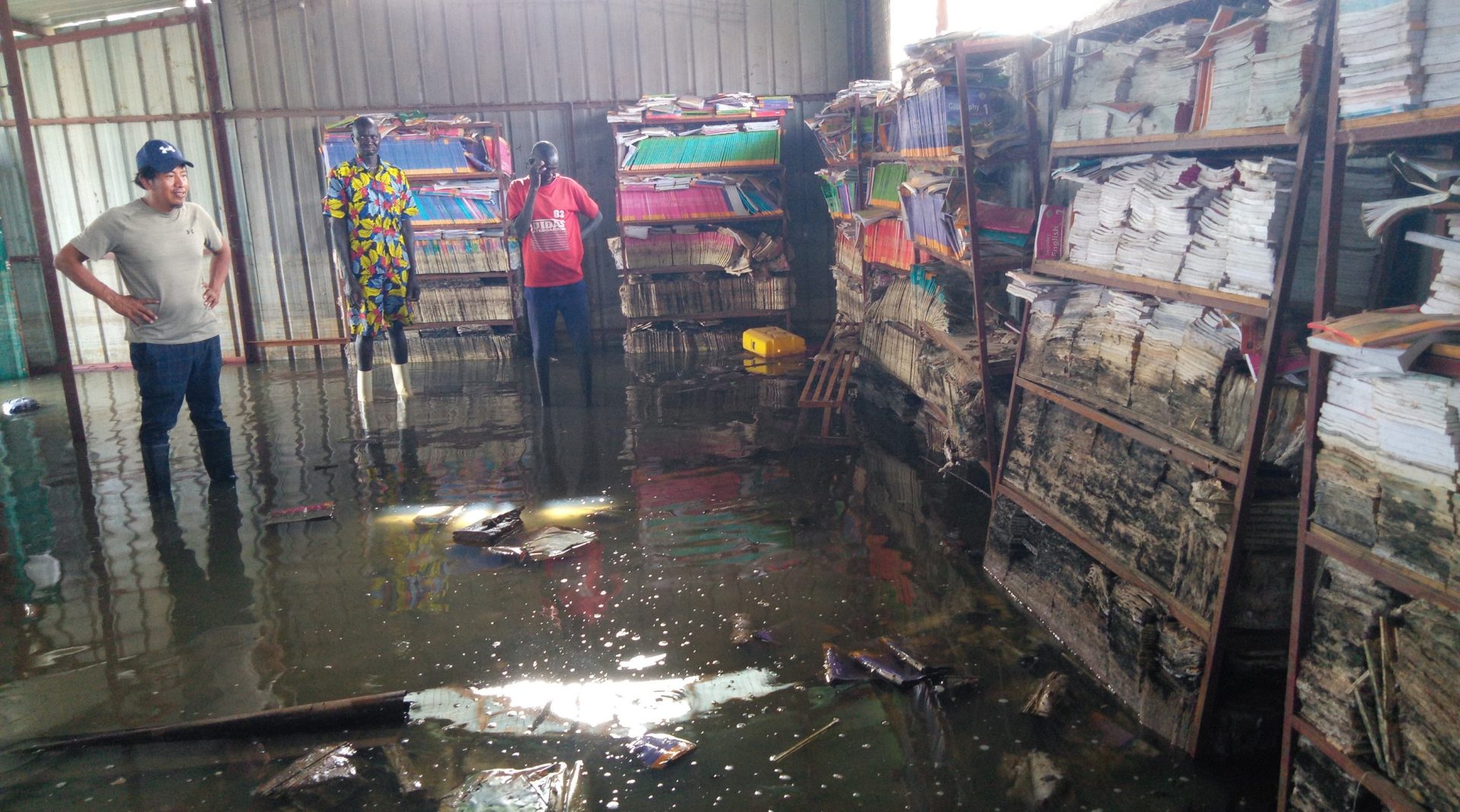
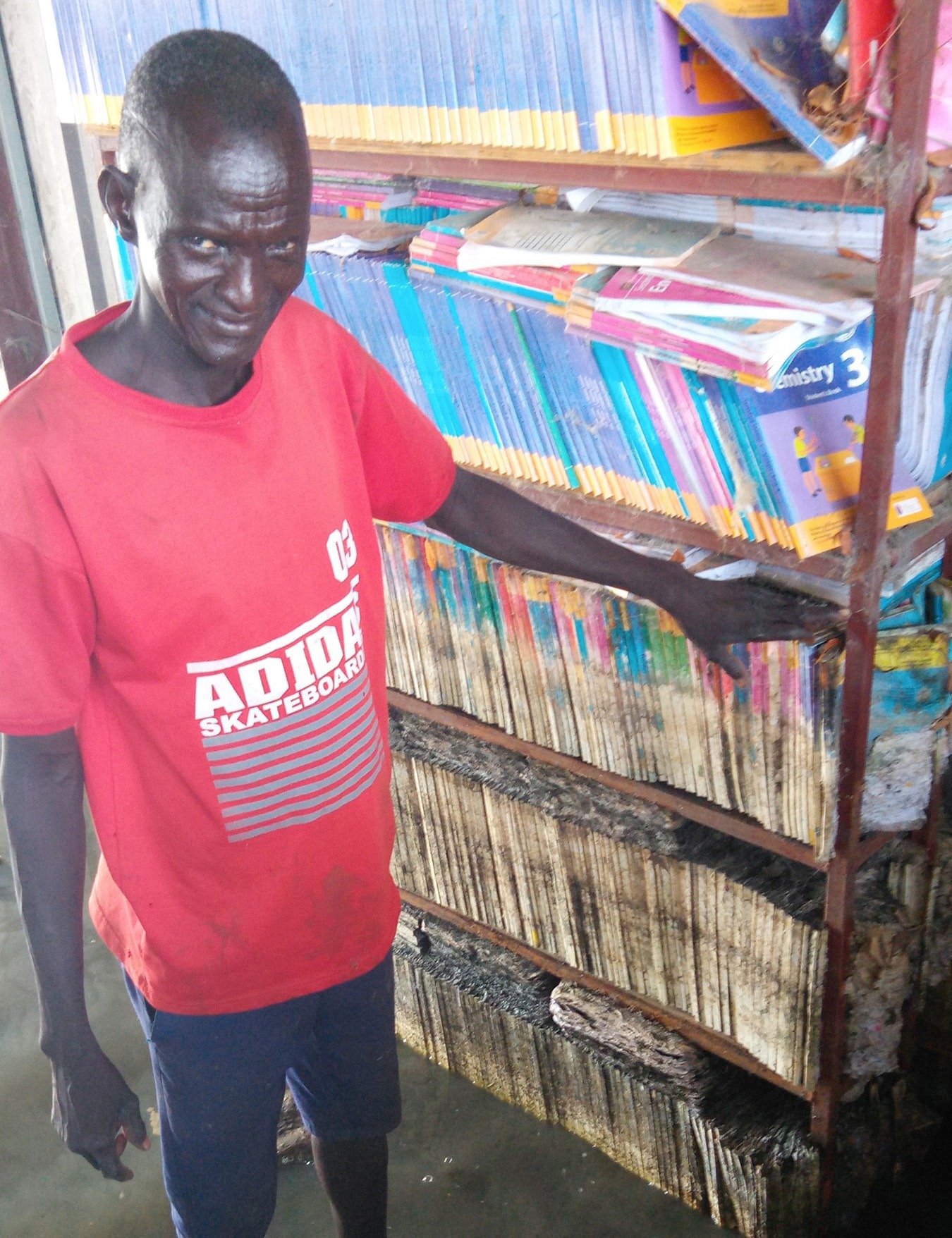
Though the floodwaters have still not receded completely, workers are taking stock of the damage to the school’s books.

The Comboni mission has been flooded before, but this time the water has stayed and the people have fled, leaving the dikes to be worn away.
The Comboni mission has been flooded before, but this time the water has stayed and the people have fled, leaving the dikes to be worn away.
By: Kathleen M. Carroll
Father Gregor Schmidt, mccj, has spent enough years in South Sudan to recognize that hardship is nothing new. Civil war, displacement, food shortages, and seasonal flooding have long shaped life in the world’s youngest nation. But what he has witnessed over the past several years is different.
“This isn’t the kind of flood that comes and goes,” he said during a recent visit to the United States. “The water stays.”
For generations, communities along the White Nile expected the river to rise during the rainy season and retreat again months later. Since 2020, however, much of northeastern South Sudan has remained underwater. What was once fertile grazing land has become an inland sea stretching thousands of square miles. Villages have disappeared. Roads have vanished beneath the water. Entire parishes have been abandoned.
“Our parish is under water,” Father Gregor said simply.
The missionary, currently provincial superior of the Comboni Missionaries in South Sudan, has spent recent weeks traveling throughout the United States raising funds—not only for emergency relief but for something far more ambitious: helping people return home.
A Country Under Pressure
South Sudan gained independence from Sudan in 2011 after decades of conflict. Hope was high that the world’s newest nation would finally enjoy peace, but political rivalries soon erupted into civil war. Although a 2018 peace agreement formally ended the fighting, implementation has been slow and fragile. Elections have repeatedly been postponed, political tensions remain high, and millions of people continue to live as refugees or internally displaced persons.
For Father Gregor, politics is only one part of the crisis.
“The flooding has changed everything,” he explained.
The Fangak region, where Comboni Missionaries have served for years among the Nuer people, lies in the vast wetlands known as the Sudd. Seasonal flooding has always been part of life there, but in recent years exceptionally high water levels have failed to recede. Entire regions of the country have effectively become lakes. Families who once farmed and raised cattle now find themselves living on scattered islands.
People construct earthen dikes by hand in an endless effort to protect their homes. Every year those dikes require maintenance. Every year the stakes grow higher.
When War Reached Old Fangak
Then, in May 2025, violence compounded the disaster.
Old Fangak, one of the area’s largest communities, had already become an island protected by an earthen dike surrounding roughly 20,000 residents. Because roads no longer existed, nearly everything—from food to medicine—arrived by boat.
On the morning of May 3, helicopter gunships attacked the town.
Father Gregor described hearing how aircraft flew low along the river, firing into the community before striking the hospital area and marketplace. Seven people were killed, and many others were injured.
Independent reports from Médecins Sans Frontières (MSF) confirm that helicopter gunships bombed the organization’s pharmacy, destroying it completely before firing on the town for approximately 30 minutes. A later drone strike hit the market. The attack left at least seven people dead and about twenty injured while effectively destroying the only functioning hospital serving more than 100,000 people in Fangak County.
“The only reason the world heard about it,” Father Gregor observed, “was because the MSF pharmacy was destroyed.”
Médecins Sans Frontières enjoys a place in the international spotlight, and rightly so. But for many communities across South Sudan, Father Gregor said, violence often goes unnoticed unless an international organization becomes involved.
Then the Water Won
Fear spread quickly after the bombing. Many women and children fled about twelve miles west to the next patch of dry ground. With so many residents gone, too few people remained to maintain the protective dike.
On the night of August 30, the barrier finally failed.
Water poured through the breach and flooded what remained of Old Fangak. MSF later evacuated more than one thousand residents from the town, describing catastrophic flooding that forced families to flee with little more than the clothes they were wearing.
Even today, Father Gregor said, two watchmen sleep on the roof of the provincial residence to discourage looting. Everything else has been abandoned.
The missionaries themselves relocated to Paguir, where they now live under conditions little different from those of the displaced families they serve.
Their homes are temporary shelters made from mud walls, tree branches, and plastic sheeting supplied by humanitarian agencies. Water and sanitation are poor. Cholera remains a constant threat.
“They live like the refugees,” Gregor said.
Despite the enormous humanitarian response in South Sudan, rebuilding the dike has fallen into an unexpected gap.
“There are many NGOs,” Father Gregor explained. “But each one has its own mandate.”
One organization may provide medical care. Another distributes food. Another specializes in sanitation. None is responsible for reconstructing an earthen flood barrier.
So the responsibility has fallen largely to the Church.
The Comboni Missionaries have secured approximately $100,000 to hire local young people to rebuild the damaged dike largely by hand, using earth reinforced where possible with concrete. An engineering assessment suggests the repaired structure could protect the community for another five years—perhaps long enough for water levels finally to decline.
For Father Gregor, rebuilding the dike is not simply an engineering project.
It is the first step toward restoring an entire community.
Rebuilding More Than a Town
If the dike can be restored, Father Gregor believes the people of Old Fangak will return.
That hope shapes every decision the missionaries are making today.
“The school year begins in February,” he said. “We hope the people—and the missionaries—can resettle there.”
The work ahead extends far beyond moving dirt.
Homes must be rebuilt. The mission compound must be restored. Schools need walls, roofs, desks, cupboards, dining tables, mattresses, and books. Floodwaters ruined nearly everything, including stacks of school texts that children depended upon for their education.
“There isn’t even enough dry land to build a school right now,” Father Gregor explained.
His phone holds photographs of soaked books, collapsed buildings, and classrooms reduced to mud. They are reminders that disasters do not end when the headlines fade. Long after emergency relief arrives, communities face the slow, expensive work of rebuilding ordinary life.
That is where the Comboni Missionaries hope to remain.
“We have funding for the dike,” Father Gregor said. “But afterward we will need help rebuilding the town.”
Another Crisis in Juba
Even while responding to the disaster in Fangak, Father Gregor is asking supporters to remember another emergency unfolding hundreds of miles away in the nation’s capital.
Juba, South Sudan’s largest city, continues to attract thousands of families fleeing violence, hunger, and flooding. Many arrive with nothing. Some children become separated from relatives. Others lose parents to war or disease. Still others simply have nowhere safe to live.
“The situation is getting worse,” Father Gregor said.
A small ministry that began with several laywomen and a South Sudanese priest now provides daily care for approximately 60 to 70 children, some as young as three years old. The program offers food, safety, education, and a chance to build a future.
In many cases, the missionaries help children enroll in boarding schools, providing the stability they cannot find at home.
Father Gregor also described another heartbreaking reality: when mothers are imprisoned, their young children often remain with them behind bars because there is nowhere else for them to go. “The neglect of children is a real issue,” he said.
Like so much of the Church’s work in South Sudan, these ministries receive little international attention. Yet they quietly continue day after day through the dedication of priests, religious sisters, and lay volunteers who refuse to abandon the country’s most vulnerable people.
Among them are the Sacred Heart Sisters, who serve marginalized communities with education, health care, and pastoral outreach despite the same hardships facing everyone else.
Choosing to Stay
Father Gregor’s own travels illustrate the unusual rhythm of missionary life today.
Each year he spends months visiting supporters throughout Europe and North America, preaching in parishes, speaking to mission groups, and sharing the realities facing South Sudan. During this visit to the United States, he has also met with scholars working to preserve Nuer language and culture, including efforts to publish a Nuer-English dictionary.
These trips are essential. Without them, many of the projects now underway would never be funded.
Yet his attention remains fixed on South Sudan.
He speaks less about statistics than about people: the watchmen guarding an abandoned mission house, families living beneath plastic sheeting, children studying without classrooms, and young workers preparing to rebuild a dike with little more than hand tools.
Again and again, his stories return to the same truth: The Church stays.
When roads disappear beneath floodwaters, the missionaries travel by boat. When communities are forced to relocate, they relocate with them.
When schools wash away, they begin planning new ones. When hospitals are bombed, they continue caring for the wounded.
That steadfast presence reflects the missionary vision of St. Daniel Comboni, who insisted that evangelization begins not with programs but with sharing the lives of the people.
Hope Built by Hand
It would be easy to look at Old Fangak and see only loss — a flooded town, a destroyed hospital, thousands displaced, and an entire generation growing up in temporary shelters.
Yet Father Gregor sees something else. He sees young men willing to spend weeks rebuilding a dike by hand and parents determined to send their children back to school, despite the challenges. He sees a community that believes home is still worth reclaiming.
And he sees missionaries who refuse to leave.
For supporters thousands of miles away, rebuilding a dike may not sound like missionary work.
But in South Sudan, protecting a community from floodwaters means protecting families, schools, churches, clinics, and the possibility of a future.
“The first step,” Father Gregor said, “is rebuilding the dike.”
Everything else—homes, classrooms, books, livelihoods, and hope—can begin only after the water is held back.
In a country that has known decades of war and years of devastating floods, that simple act of rebuilding becomes a profound expression of faith: a declaration that life will return, children will learn again, and God’s people have not been forgotten.
