
By: Enrique Bayo
The Africa-Europe Faith and Justice Network denounces realities such as land grabbing and encourages projects in favor of peace and development in Cameroon.
The Cameroonian branch of the international organization Africa-Europe Faith and Justice Network (AEFJN) was founded in 2010 by several missionary congregations with the aim of promoting justice and defending human dignity in the light of God’s Word. By focusing on networking and close collaboration between religious and lay people, the branch brings life and hope to thousands.
The Catholic institutes of consecrated life in Cameroon are united in the National Conference of Major Superiors. At the headquarters of this institution, located in the Mvolyé neighborhood of Yaoundé, I meet Sister Geny Maria da Silva, a Brazilian Comboni missionary who has been working in the Cameroonian branch of the Africa-Europe Faith and Justice Network (AEFJN) since arriving in the country in 2019.
The AEFJN-Cameroon coordination team, known locally as the Faith and Justice Association, is made up of five people: two religious and three laypeople. Besides the Brazilian woman, the only non-Cameroonian on the team, the other religious member is Father Simon Valdez Ngah, from the Congregation of the Missionaries of the Sacred Hearts and the national coordinator for the branch. Among the laypeople, I know Joël Nomi, a lawyer who, from a young age, felt a connection to the beatitude of those thirsting for justice and wanted to study law to follow this vocational calling.
AEFJN-Cameroon focuses its work on five fundamental axes that Fr. Valdez lists in a concise way: prevention of drug circulation and consumption in schools, support for communities affected by land grabbing, social cohesion programs with internally displaced persons – especially those affected by the conflict in the Amazon region –, social integration projects for young people with disabilities, and strengthening of psychosocial capacities among religious men and women.
Although the harvest is plentiful for so few laborers, Fr. Valdez clarifies that “we are not alone. We are religious, and in each ecclesiastical province we have groups of religious men and women, but also of lay people, deeply committed to the pursuit of social justice. With them, who help us gather information on the ground, we organize our activities.”
Furthermore, the national coordinator highlights the excellent collaboration they maintain with diocesan bishops and diocesan Justice and Peace Commissions wherever they exist. AEFJN-Cameroon is also part of civil society platforms such as the Food Sovereignty Alliance and the Platform for Combating Drugs, with which it collaborates regularly. Behind this diverse network of relationships and synergies lies the secret to “the small results we experience, which give us great joy and encouragement to continue our work,” says Father Valdez with satisfaction.
Land grabbing
In Cameroon, as in other African countries, the number of people whose lands are being expropriated is increasing. Joël Nomi is very familiar with this phenomenon and points to two types of fraudulent land accumulation. On the one hand, there are foreign multinationals that request land from the state in exchange for large sums of money. In this case, the government acquires the land by circumventing legal procedures, without compensation, and violating the local population’s right to live. Another type of exploitation that is spreading involves local officials with considerable economic power and influence who obtain property deeds and dispossess communities of their land.
Faced with situations like this, “our first action is to support the communities so they become aware that they have the right to claim their land and that, moreover, only they have the capacity to do so, because no one can replace them. We inform them about the land laws in force and guide them to rely on traditional leaders and customary law. Most people don’t have land titles, and the land is passed down from one generation to the next, but this continuity in land use is a source of law in Cameroon,” Nomi points out. The communities face very powerful adversaries, hence the importance of organizing themselves because “making claims in a fragmented way doesn’t work,” the lawyer asserts with conviction.
Nomi recalls the case of Ambam, a department in the Ntem Valley, where in 2021 a local group, led by a Cameroonian company based in Yaoundé, fraudulently expropriated more than 31,000 hectares affecting 21 villages to develop the Plants et Aquaculture du Cameroun (PAC) project. AEFJN-Cameroon encouraged the population to denounce this violation, alerted the press, and organized informational workshops. Thanks to this mobilization, Cameroonian Prime Minister Joseph Dion Ngute canceled the PAC, and the land was returned to the communities. “It was a time-consuming task that required numerous trips to the area, but in the end, you’re left with the joy of having contributed to stopping this injustice,” the lawyer notes with satisfaction.
Drugs
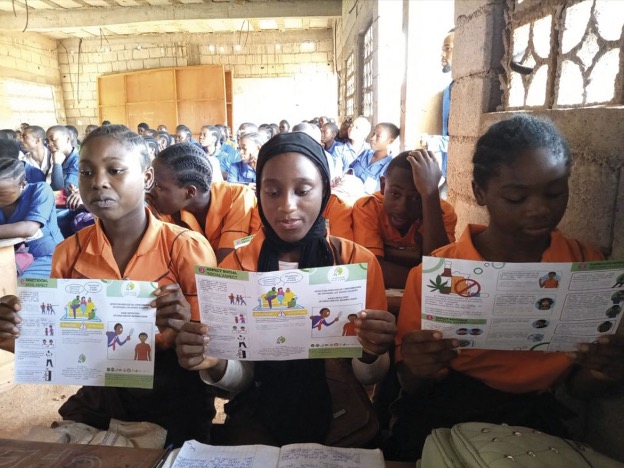
The rise in drug use among young people is another challenge for AEFJN-Cameroon, which they are addressing through the Platform for the Fight Against Drugs. “We focus our awareness-raising work primarily in schools and parishes, trying to instill good habits among young people,” says Father Valdez.
In these sessions – and in talks where young people are warned about the dangers of illicit substance use – they place great importance on meetings with teachers, youth leaders and parents, in which they address issues such as the need to protect young people, the detection of signs that warn that a young person is using drugs or the steps to take to accompany someone who wants to stop.
In schools, in addition to prevention efforts, the Cameroonian branch organizes sessions on environmental and ecological issues, Sister Da Silva explains. She adds that “the cry of the earth and of the poor is a constant challenge that demands we promote integral ecology,” as proposed by Pope Francis in the encyclical Laudato si’ . Father Valdez adds that the branch is advocating “for the inclusion of environmental education in the school curriculum and also in pastoral care.”
Social cohesion
Another area of focus for EAFJN-Cameroon is the armed conflict that has pitted the Cameroonian government against various separatist groups in the two Anglophone regions of western Cameroon since 2017. As a result of this crisis, more than a million people from the Ambazon region have sought refuge in other parts of the country. In some areas, the presence of internally displaced persons is causing serious problems of coexistence.
The social cohesion program for internally displaced persons (IDPs) run by AEFJN-Cameroon begins with organizing training sessions for religious men and women in the area. The goal is for them to be the first to “inform and raise awareness among the local population and facilitate the reception of the IDPs,” explains Father Simon Valdez. The program also proposes concrete measures to ensure that IDPs in rural areas have access to land to cultivate without having to pay rent. Then, at the end of the year, depending on their harvest, they can give a portion of the produce to the landowner.
Another important aspect of these programs is to challenge local authorities on their obligation to ensure the reception of displaced persons, making all available resources in the area accessible, such as health centers and water sources. According to the legal expert at the regional office, “Local populations also suffer from a lack of resources, and the entire burden of reception cannot fall on them; that is why the involvement of the authorities as regulators of coexistence is so important.”
Psychosocial training
Between December 2024 and early 2025, AEFJN-Cameroon organized training sessions in the country’s five ecclesiastical provinces on strengthening the psychosocial capacities of religious men and women, although some diocesan priests and catechists also participated. The aim of these meetings was to offer useful tools for managing trauma and painful past experiences, not only for internally displaced persons, but for all types of people affected by these problems addressed by the AEFJN.
The coordinator of AEFJN-Cameroon acknowledges that in the country, “it is difficult to find specialized psychological services, and many people come to the Church to be heard, share their experiences, and ask for advice to free themselves from their traumas. The problem is that we religious are not always well-trained for this type of support and can even create more harm than good. The most common approach is to spiritualize everything, to say ‘let’s pray’ and leave it at that, without suspecting that the person also needs specialized help.”
In total, some 180 people have received this training and are now called upon to teach others what they have learned. The content was delivered by members of the Commission of Psychologists of the National Conference of Major Superiors and by professionals from two organizations: the RAPHA-Psy Psychology Foundation and the NGO Bring Light Save Live, a member of the World Federation Against Drugs.
Challenges
The three members of the AEFJN-Cameroon coordination team interviewed all agree that financial issues are their main challenge. “We are very concerned about the lack of money for the normal development of our activities, especially if we have difficulty paying the people who work with us,” says Sister Geny Maria da Silva.
AEFJN-Cameroon receives support from the Episcopal Conference and the National Conference of Major Superiors. They also collect donations from volunteers and religious congregations, in addition to a small annual contribution from AEFJN’s Brussels office. But it’s not enough. “Without the support of Missio Aachen and the Roncalli Foundation, it would have been impossible to organize the training sessions to strengthen psychosocial skills,” says Father Valdez, who bitterly laments the lack of financial support from the Cameroonian government. In his opinion, the government doesn’t take issues related to justice and peace seriously. To demonstrate this, he provides a thick binder of documents. “These letters are requests for help from different ministries and public institutions. They always respond politely, acknowledging receipt, but never offering money,” says the priest, adding: “The Ministry of Health should be concerned about the increase in drug use among young people, but whenever we ask for help to subsidize our awareness sessions in schools, we never receive a response.” The national coordinator also laments that they have had to reduce support for communities affected by land grabbing due to a lack of resources for travel expenses.
In addition to its website and social media presence, AEFJN-Cameroon publishes the Shema newsletter every three months to inform and raise awareness about its projects and programs. They print 450 copies, which they distribute free of charge to congregations, partners, NGOs, and institutions. They are also encountering difficulties in funding this small publication.
Another challenge they point out is the lack of prophetic voices within the Church. From our vantage point, “we prepare reports on what we observe on the ground and give them to the bishops, because they are the ones who must present them to the public and to politicians,” says Father Valdez, implying with a gesture that most prelates do not live up to expectations.
Social inclusion
After the interview, I realized I’d forgotten to ask about the social integration work for young people with disabilities, one of AEFJN-Cameroon’s five key areas of focus. To remedy this, they gave me documentation with a detailed explanation. These projects are carried out in parishes and schools across four dioceses—Garoua, Bertoua, Bafoussam, and Yaoundé—and aim to prevent the exclusion of teenagers and young adults with deafness, speech impairments, mental illness, or visual impairments. They also provide support to the albino population. Organizing workshops, awareness sessions, and developing materials are some of the methods used to implement these projects.
I leave the headquarters of the National Conference of Major Superiors happy to have found a group of committed people endowed with an “active faith” – as Fr. Simon Valdez likes to say – who, with great simplicity and humility, are achieving authentic miracles and are true “messengers and builders of hope”.
